
Local businesses have always competed on proximity and personal relationships — things no national chain can replicate. What they've historically struggled to match is content volume. A regional coffee chain might post one video per week; Starbucks has a dedicated content team running daily creative at scale. AI video is the first tool that closes that production gap without requiring a marketing department.
Why Local Business Video Marketing Has Changed#
A few years ago, local business social media meant posting a smartphone photo of the daily special and hoping someone noticed. The platforms have moved on. TikTok, Instagram Reels, and Google Business Profiles all now heavily favor video content in discovery — and discovery is where new local customers begin.
The stakes are concrete: Google reports that businesses with video on their Google Business Profile receive 2× more views than those with only photos. Instagram's algorithm gives Reels 30–40% more distribution than static posts to non-followers, which is the only population that matters for local customer acquisition. Local businesses that aren't producing video consistently aren't competing for new customers on the platforms where those customers are looking.
The traditional barrier was production cost. A professionally shot 60-second brand video used to cost $2,000–$8,000 depending on crew and location. That price point made video a one-time event — a "brand film" shot annually, not a content program that compounds week over week. AI video drops the marginal cost of a new video to near zero, which means local businesses can publish with the same frequency as the big brands they're competing against for local search placement and social feed presence.
The Video Formats That Drive Local Foot Traffic and Sales#
Not every video format serves local business goals equally. These are the formats that generate real customer action — visits, bookings, orders — rather than passive engagement.
Showcase and Atmosphere Videos#
For most local businesses, the primary purpose of social video is getting a potential customer to think "that looks like somewhere I'd go." A restaurant needs to communicate that its atmosphere is warm and the food looks worth the drive. A gym needs to show that its equipment is current and the space isn't overcrowded. A salon needs to convey the aesthetic and the vibe before a new client is willing to book.
Atmosphere videos work on a simple logic: they answer the "do I want to be there?" question before the customer has to ask it. A 15-second walkthrough of a well-lit bakery showing fresh pastries in a case, warm wood interiors, and a couple of people at tables with coffee earns more reservation intent than any description of the menu.
Example prompt: "Interior of a modern neighborhood bakery, warm morning light from large windows, fresh croissants and pastries arranged in a glass case, warm wood countertops, a few café tables in the background with customers; slow pan across the pastry case, camera at counter height; the scene should feel quiet and inviting, like a Tuesday at 8am; natural, non-staged warmth; 9:16 vertical framing"
UGC-Style Customer Testimonial Content#
The most persuasive content for any local business is a real-seeming customer talking about why they keep coming back. Not a scripted testimonial shot in front of a white backdrop — content that looks like a customer recorded it themselves because they were genuinely happy.
UGC-style video ads follow a specific visual language that AI can reproduce: slightly imperfect framing, natural ambient lighting, conversational delivery with occasional pauses, specific details about what they liked rather than vague praise. A customer saying "I've tried every sushi place in this neighborhood and the only one I actually come back to is this one — the quality is consistent every time, which is rare" is 10× more persuasive to a local audience than "we use only the freshest ingredients."
Example prompt: "Woman in her late 20s speaking to camera on a city sidewalk outside a restaurant, casual afternoon lighting, she's just finished eating and sounds genuinely pleased; she mentions a specific dish, a specific thing that surprised her, why she's coming back; handheld feel, 9:16, casual register; visible in the frame: restaurant exterior window behind her"
Before-and-After and Process Content#
For service businesses — hair salons, contractors, landscapers, auto detailers, cleaning services — the highest-converting video format is the transformation reveal. A before-and-after of a kitchen remodel, a lawn landscaping job, or a car detail shows the actual value being delivered in a way that no list of services can.
Process content works alongside transformation reveals: a 20-second timelapse of a pizza being made from dough to delivery, a time-compressed version of a furniture repair, or a behind-the-scenes of what goes into a catering setup for an event. Process content builds trust by demonstrating craft — it shows that real work happens and that the people doing it know what they're doing.
Promotional and Time-Limited Offer Videos#
Promotional video — announcing a weekend special, a seasonal menu item, a limited booking window — performs significantly better as video than as static posts for one simple reason: motion creates urgency in a way a static image doesn't. A counter showing a sale ending at midnight, a last-available-slots prompt for a booking calendar, a slow reveal of a new seasonal dish all create a sense of event that earns clicks.
Keep promotional video short: 5–10 seconds for a simple offer announcement. The goal is pattern interrupt, not explanation. The viewer who registers "weekend brunch special, $18, this Saturday only" will click through to the link if they're interested. They don't need a full 30-second video to make that decision.
How to Create AI Video Without a Marketing Team#
The production workflow that works for a local business with limited time:
Step 1 — Pick one format per week. Don't try to produce atmosphere content, a testimonial, and a promotional video in the same week. Pick a single format that matches your current business priority — filling slow Tuesday nights means promotional, acquiring new customers who don't know you exist means atmosphere.
Step 2 — Write a reusable prompt library for your business. Spend one session developing five to seven core prompts that define your business's visual language — the lighting, the interior setting, the customer types, the aesthetic. These become reusable templates that you modify rather than rebuild from scratch each time.
Step 3 — Batch-generate content for the next two to four weeks. Generate all your atmosphere content for the month in one session, all your promotional content in another. Batching within a format keeps your visual output consistent — the same color temperature, the same interior environment, the same brand feel — rather than producing content that looks like it came from different sources.
Step 4 — Schedule at least three posts per week. Consistent publishing frequency matters more than occasional high-quality posts for platform algorithm favorability. Local business accounts that post three times per week maintain algorithmic relevance; accounts that post once per week lose it.
Platform Strategy for Local Businesses#
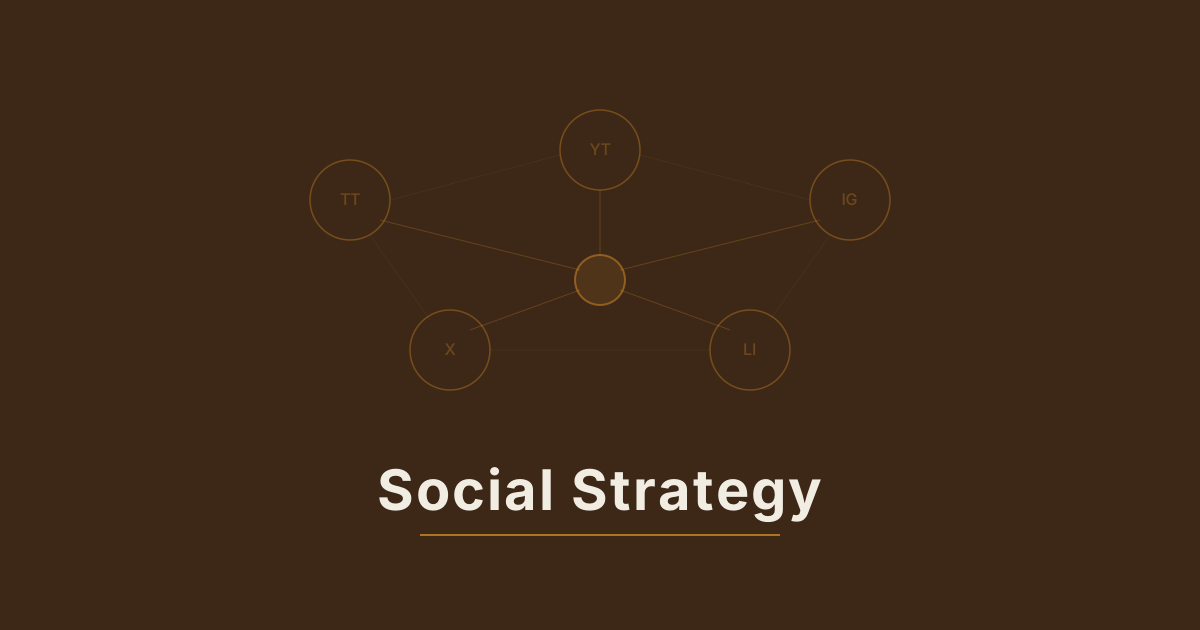
Each platform where local customers discover businesses has a different content register.
Google Business Profile is the highest-intent discovery surface for local business — the person seeing your profile is actively searching for what you do, right now, in your area. Video on Google Business Profile gets displayed during search results and Maps exploration. Keep these videos 30–60 seconds, focused on showing the space and the product quality. The viewer is comparison-shopping three or four options; the video that shows the clearest, warmest representation of what to expect wins the consideration set.
Instagram Reels is where local businesses build a following and earn social proof from the neighborhood audience. The format that performs best for local accounts is hyper-local — content that acknowledges specific neighborhoods, seasonal local moments, or community events. A bakery in Austin mentioning the upcoming Sixth Street festival in a post about their new seasonal pastry earns local resonance that a generic pastry video doesn't.
TikTok rewards behind-the-scenes content from local businesses at a disproportionate rate because the format fits the platform's discovery engine. Content that shows the unglamorous reality of running a small business — the 5am prep, the delivery that arrived wrong, the customer who became a regular — earns organic reach from people who weren't looking for your business but find it compelling. A local restaurant owner documenting what it actually looks like to prep for a Friday dinner service can build a local following of thousands in six weeks, with no advertising spend.
Nextdoor and neighborhood Facebook Groups are underused by most local businesses and still reward video over text posts. A 30-second video of your space posted in a neighborhood group with a genuine message ("we just started a Tuesday tasting menu if anyone wants to try new dishes before we put them on the menu — here's what we're testing this week") earns engagement from a highly local, highly relevant audience.
Example Prompts for Six Local Business Types#
Restaurant or Café: "Warm-toned restaurant interior at dinner service, ambient candlelight on tables, bartender visible in background; camera focuses on a freshly plated pasta dish being set on a table; slow push toward the plate, steam rising slightly from the sauce; 9:16, soft warm color grade; no dialogue; atmosphere-focused"
Hair Salon or Barbershop: "Before-and-after hair color transformation; first frame: woman with faded, grown-out highlights; transition: hands working through freshly colored hair at a styling chair; final frame: styled, vibrant finished color under salon lighting; warm and bright interior; 9:16, the process implied rather than shown in full"
Gym or Fitness Studio: "Modern boutique fitness studio interior during a class, natural light from large windows, 6–8 people mid-workout, instructor visible; camera slowly sweeps the space at shoulder height; energy is focused and calm, not chaotic; equipment is clean and high-quality; 9:16 vertical framing, no faces in sharp focus, motion-forward"
Law Office or Professional Services: "Calm, professional office interior, warm neutrals, a desk meeting between two people visible in the background; camera is positioned from a comfortable angle, neither cold nor overly formal; the space communicates expertise and accessibility rather than intimidation; 9:16, natural afternoon light, no specific identifiable branding"
Landscaping or Home Services: "Time-compressed aerial view of a backyard landscaping project: bare yard in the first frame, finished with new lawn, planted borders, and stone path in the final frame; the transformation covers 45 seconds in fast-forward; drone-style movement tracking from the back of the yard toward the house; warm late-afternoon light; 16:9 for YouTube, title text space left at top"
Retail Boutique: "New-arrivals walkthrough in a small clothing boutique; camera slowly pans a rack of spring pieces, pausing on each garment; warm afternoon window light, the rack is styled with intentional coordination; the feel is a friend sharing what's new, not a brand broadcast; 9:16 vertical"
Measuring What Matters for a Local Audience#
Standard social media metrics don't tell local businesses what they need to know. Vanity metrics — likes, impressions — mean nothing if they're not translating into the specific behaviors that matter: walk-ins, bookings, calls, direction requests.
Track direction requests from your Google Business Profile after posting video content there. Google Business Insights shows how many people clicked "get directions" — the highest-intent action available from a local search result. A spike in direction requests after a video post is a direct causal signal.
Monitor profile visit rate from Reels and TikTok. A high profile visit rate indicates that the content made someone curious enough to investigate the business further. For local discovery content, profile visits are the step immediately before a direct message, a click to website, or a call — the actions that matter.
Ask new customers how they found you. The clearest signal is the conversation at the point of sale. "How did you hear about us?" answered consistently with "TikTok" or "Instagram" tells you more than any analytics dashboard. Track this informally for 30 days after starting a video content program and you'll see the channel contribution that attribution software often misses for local accounts.
Set a 90-day baseline. Local business video content builds audience and algorithmic authority over time rather than delivering immediate spikes. A new business posting three times per week consistently from today should expect to see meaningful follower growth and increased discovery traffic by month two, and measurable impact on customer volume by month three. A sustainable video strategy compounds rather than spikes.
The competitive advantage for local businesses willing to invest in consistent video is real and defensible: national chains have budgets but not your authenticity, your community relationships, or the trust that comes from your neighbors seeing your face every week in their feed. If you want to build that video presence without hiring a videographer, Mango can generate the content volume that makes it sustainable — from atmosphere showcases to promotional content to UGC-style material, produced in batches at a pace that actually keeps up with a weekly publishing schedule.