
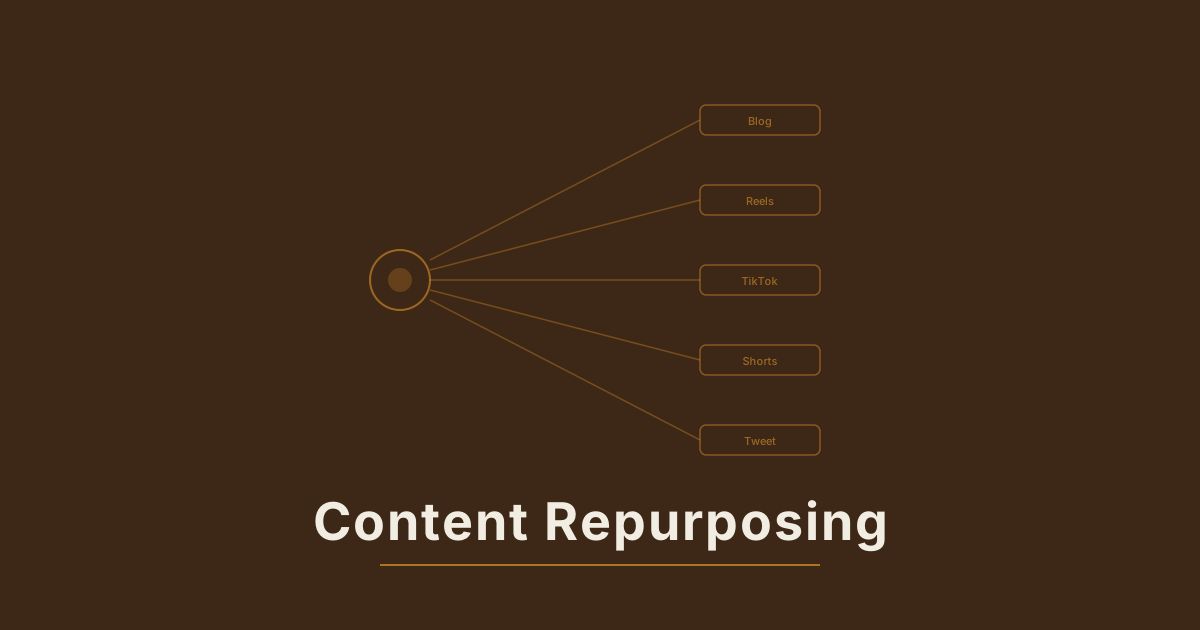
Every piece of long-form content you publish — a podcast episode, a blog post, a recorded webinar — already contains 30 days of social posts. The problem isn't having enough ideas. It's having a system that extracts them without spinning up a full production cycle for every derivative.
An AI content repurposing strategy is that system. It takes one high-quality source asset and generates platform-native posts at a pace that would require an entire content team doing it manually.
Why Content Repurposing Beats Creating from Scratch#
The math is straightforward. A 30-minute podcast episode contains roughly 5,000 spoken words. At 150 words per short-form video script, that's the raw material for 33 clips — before you've extracted a single insight, isolated a single moment, or written a single caption.
Creating original content for every post means starting the creative cycle from zero each time: ideation, scripting, visual production, captioning, publishing. Each post carries the full cost. Repurposing inverts that structure. Invest once in the source asset, then extract derivatives at a fraction of the marginal effort.
The compound effect matters too. Content that exists across multiple formats, lengths, and platforms reaches audiences at different points in their consumption habits. A viewer who never watches YouTube might absorb the same insight from a 45-second Reel. The person who skimmed the blog post saves the summary video. The LinkedIn reader who missed the podcast share the written pull-quote. Repurposing isn't duplication — it's distribution at higher resolution.
The economics at scale. A brand publishing one original piece per week and repurposing intelligently can maintain a daily presence across four platforms from four hours of total weekly production time. A brand creating original content per platform would need 15–20 hours to achieve the same publishing frequency — and would exhaust its ideas before the end of the month.
The Repurposing Audit: What Content to Start With#
Not all source content repurposes equally well. The highest-value candidates share specific characteristics.
Depth of coverage. A 600-word social post has too little raw material. A 30-minute interview, a 2,500-word guide, or a 45-minute webinar has more than you'll fully use. Look for pieces that cover a topic exhaustively — the kind of content you'd save or reference, not scroll past.
Standalone insights. The best repurposable content contains moments that work independently of the surrounding piece. "Our conversion rate went from 1.2% to 4.7% after one change" is a standalone insight. A five-minute explanation of that change generates five 45-second videos, each isolating one element of the explanation.
Evergreen relevance. Content tied to a specific campaign, a time-limited offer, or a calendar event repurposes poorly — the derivative posts expire on the same schedule as the original. Evergreen topics — process guides, frameworks, foundational concepts, performance principles — generate derivatives that work as well six months from now as they do today.
The quick audit. Before committing to a repurposing sprint, scan the source: how many distinct insights does it contain? How many could stand alone in 30–60 seconds? If the source is a recording, which moments drove the most engagement when it aired? If you can identify ten standalone moments, you have the raw material for a month of posts.
The AI Repurposing Stack: Tools and Their Roles#
The efficiency of an AI content repurposing workflow depends on having the right tool for each stage of the process. The common mistake is expecting one tool to handle everything.
Transcription and extraction. Whisper-based transcription services convert audio and video to searchable text accurately enough for production use. The output becomes the raw material for every derivative you'll generate. Accuracy matters here because errors in the transcript propagate through everything downstream. Expect 95–98% accuracy on clear audio; manually correct speaker names and technical terms before moving forward.
AI writing tools for script adaptation. Once you have a transcript, AI writing tools extract and reformat insights for platform-native delivery. A 300-word section from a podcast transcript becomes a 90-second short-form video script with a hook, three supporting points, and a close. The same section becomes a LinkedIn text post, a tweet thread, and a 75-word Instagram caption. The key is giving the model specific formatting constraints: "write this as a 75-word TikTok hook with a punchy opener" produces far better output than "make this shorter."
AI video generation for visual derivatives. For content that includes tips, frameworks, or numbered steps, AI video generation creates visual posts without a camera. A five-step framework extracted from a webinar becomes five separate short-form clips — one step per video, each visually distinct. AI video generation has made this derivative format commercially viable at a scale that previously required a full production team.
Scheduling and distribution. The final layer is delivery. Bulk-upload scheduling tools let you input a full month of repurposed content in one session. This is where the time savings from the upstream workflow become tangible: instead of daily publishing decisions, you make all distribution choices at once.
Platform-by-Platform: What Each Format Actually Needs#
Repurposing doesn't mean resizing. Each platform has distinct format requirements, audience expectations, and algorithm behavior that determine whether repurposed content performs or gets ignored.
TikTok and Instagram Reels (15–60 seconds). These platforms reward novelty of entry — the first one to two seconds decide whether the content earns a watch. Source content needs reformatting so the hook lands first. Extract the most counterintuitive or specific insight from a longer piece and lead with it. "Most creators batch content wrong — here's why it's costing you reach" outperforms starting with the explanation every time.
Optimal repurposed length: 30–45 seconds for Reels, up to 60 seconds for TikTok. AI video generation is highly efficient here — extract the insight, generate 30–40 seconds of visual content matched to a narration track, and post without appearing on camera.
YouTube Shorts (up to 60 seconds). Shorts algorithms weight watch-through rate more heavily than TikTok does. Content that sustains attention through the full clip outperforms content that hooks aggressively but loses the viewer at the halfway point. The repurposing move: extract source moments that have a clear narrative arc — setup, tension, resolution — rather than isolated tips without context.
LinkedIn (60–90 seconds for video; 150–300 words for text). LinkedIn rewards depth and professional framing over entertainment register. A casual podcast clip that works on TikTok often lands flat on LinkedIn because the tone is wrong. Repurposing for LinkedIn means reformatting the same insight with a professional application angle — "here's what this means for your team's workflow" rather than "here's what this means for you."
Twitter/X (threads and short clips). Twitter threads perform when each tweet is a complete thought rather than a continuation. Take a seven-step framework from a longer piece and write each step as a standalone tweet that delivers value independently. The thread format earns shares when readers want to share individual tweets, not just the full thread.
Email newsletters. Repurposing to email is often skipped but frequently high-value. A long-form post becomes the featured section of a newsletter; the newsletter links back to the full piece. Subscribers who encounter the same insight in two formats show meaningfully higher retention than those who encounter it once.
The 30-Day Repurposing Calendar from One Source Piece#

This is the operational core of an AI content repurposing strategy. The framework assumes a single high-quality source — a 30-minute podcast, a long-form blog post, or a recorded webinar.
Week 1: Direct extracts. Pull five to seven standalone insights from the source. Each becomes one short-form video (30–60 seconds). These are the closest derivatives — same information, adapted for platform format. Generate all five in a single batch session, schedule one per weekday.
Example prompt for a direct extract: "Here's a 200-word section from a podcast on social media strategy. Write a 75-word TikTok script that opens with the core insight as a hook, gives two supporting details, and ends with a takeaway. No intro, no 'in this video.'"
Week 2: Framework and process content. If the source explains a process or contains a numbered framework, unpack each step separately. A "three-step process" from your source becomes three individual videos — one per step, each going deeper than the original. AI generation makes this format efficient: use consistent visual templates across the three pieces, vary only the narration content.
Week 3: Reaction and expansion. Take the most contested or counterintuitive insight from the source and expand on it. "Here's why I said X, and what changed my mind" or "the part most people push back on." These reactive formats drive high engagement because they invite a response. A 60-second take that critiques or extends your own original insight often outperforms the original source on short-form platforms.
Week 4: Recombination and remix. Combine elements from the source to create synthetic composite content. The insight from section three of the podcast, contextualized with the example from section seven. The abstract principle alongside the specific case study that makes it concrete. These combinations often outperform direct extracts because they synthesize rather than just repeat — the derivative is genuinely more useful than any single component.
The full output. Five direct extracts in week one, three framework breakdowns in week two, five reactive takes in week three, five composite pieces in week four — plus thread posts, captions, and email content from the same source. A single 30-minute source piece generates 25–35 platform-native pieces. With AI handling script adaptation, visual generation, and caption drafts, producing a month's calendar requires four to five hours of active time.
This is what repurposing long-form content into short-form video is built for — AI has compressed the workflow to where it's practical for solo creators, not just brands with dedicated production teams.
Building the Automation Layer for Scale#
Once the framework is working, automation removes the remaining manual steps.
Prompt templates per platform. Build reusable prompt templates for each platform format — a TikTok hook template, a LinkedIn professional-angle template, a thread structure template. When you start a new repurposing session, you're filling in variables (source content, target insight) rather than building each prompt from scratch. This reduces active time per session from two hours to under 30 minutes.
Batch generation, not sequential. Run all AI video generation for the month in a single session. Batch creation workflows are the operational model: generate everything in parallel, review all outputs together, regenerate the 15–20% that miss, schedule the rest. Generating one piece at a time adds 40–60 minutes of context-switching overhead per week that accumulates into wasted hours by the end of the month.
Performance feedback into the source queue. At scale, repurpose from your best-performing content first. Track which original pieces drove the highest saves, shares, and profile visits. The insights that resonated most in their original form tend to outperform again in derivative formats. This closes the loop: analytics feed content planning, which feeds the repurposing queue, which reduces the need to create from scratch.
The Mistakes That Dilute Repurposing ROI#
Repurposing shallow source content. AI amplifies what's already there — it doesn't add depth to thin material. A 600-word listicle generates 600-word-quality derivatives at scale. The repurposing system is upstream of source content quality: fix the source first.
Platform-agnostic formatting. Posting a YouTube video unedited to Instagram is syndication, not repurposing. Platform-native repurposing means reformatting for aspect ratio, length, hook structure, and register. Content that ignores platform context performs well below its potential and signals to recommendation algorithms that the creator isn't producing native content.
Skipping the caption pass. AI writing tools produce technically correct captions that are algorithmically neutral. Captions that drive saves and shares are opinionated, specific, and invite response. AI drafts the structure; a sharp point of view that makes the caption worth sharing takes five minutes of human editing. Don't skip it.
Running the workflow ad-hoc. Repurposing without a system feels productive but produces inconsistent output. A reliable social media video strategy treats repurposing as a fixed weekly session, maintains a running queue of source content, and sets a monthly output target. Consistency in the workflow compounds into consistency in the publishing calendar, which compounds into audience trust.
The compounding advantage of a repurposing system isn't just efficiency — it's that every piece of content you've already created becomes more valuable retroactively. If you want to generate the short-form video layer of your repurposing workflow faster — AI-generated clips from your source content, ready to post — Mango is built specifically for that part of the stack.